I was asked to come up with some 'Welsh' militia for an ongoing commission, and wanted them to look distinct from the liveried 'factions' on the field of battle. I needed two solutions really, as there would be two types of militia, which needed to look different to the factions, and different to each other. The first solution was to go with mostly earthy colours, neutrals and 'vegetable' colours. This was the approach I took to the Welsh spearmen (in an earlier post), now applied to some archers too;

The recipe was simple - no body armour (except for the captain), mostly helmetless heads (including some bare heads), and the range of colours mentioned earlier. I like to put a story behind a unit, especially when I'm putting some thought into it, and the story behind these archers was that each unit was captained by either an old veteran (too old for frontline service) or else a younger knightly son, proving himself. So the captains were armoured, though not as completely as a regular men-at-arms might be.
The head selection includes the 'Brian Blessed' head from the Wargames factory Viking kit (leftmost miniature, rear rank), plus the 'hatted' heads from both the WoTR kits and the 'European Mercenaries' kit. Not visible in this image, but employed here and there, were some spare bare heads from the Warlord Games WW2 British Infantry set.
For the Captain with brigandine, I didn't want to clash with any of the liveries already being used - so I went with all-over green (sleeves too). The locals would know him, and he'd not be important enough for the Heralds to recognise his badge anyway!
Finally, the long-awaited royal Yorkist faction. I've done the colour scheme before, several times, but not on so many troops at once (63 miniatures in total). It looks even better on large units than individual models - and works quite well on football shirts too;
Because the claret / mulberry is a flavour of red, I studiously avoided any other red tones. Even slightly different reds, combined on a single model or in a single unit, can 'jar' the eye. Instead, I stuck mostly to neutrals and blues for the non-livery hose / sleeves. I toyed with using only white, which I'd done previously for a Warhammer unit, but decided it looked too uniform.
The 'Boar' badge didn't look like anything when I tried freehanding it, so rather than have mismatched badges, I just left it off the miniatures where the decal (Citadel Six) wouldn't stick - such as the Captain's brigandine.
The second archer unit has a plate-armoured captain, and it's the standard bearer who gets the unbadged brigandine this time.
"Loose!"
When trying to get a livery onto everyone, some of the Perry bodies present challenges - such as the plate-armoured chap second from left. The old trick of using livery colours reversed for his hose helps, as does giving him white sleeves, which I also employed on half his comrades. As you can see, I struggled to get a badge to stick / look good on the brigandine bodies - so it's down to colours and imagination. Another good reason for using white sleeves - the same colour as the badge, to make up for its absence.
The foot men-at-arms kit comes with a command frame including a 'Richard' and his standard bearer. It wasn't required for this commission, but I'll definitely be painting one up and showing it on here, in a future post.
Another faction in a large army commission - this time Sir Thomas Howard (Surrey / Norfolk);
Another bright colour scheme for this livery, taken right off the Perry box art. Usually, with bold schemes like this, I choose more muted tones for sleeves / hose, but this time I've mixed in some bright blue, dark yellow, and even green. This was to help differentiate this unit from other, similar-looking, red-and-white units I'd already done.
The bright mint-green is not a colour I use often, even for medievals, but I employed it when painting some militia (unliveried) units and it looked great. Look for these in other posts. The badge is very small - described by chroniclers as 'a white sallet', but looking to me like a clip-art rendering of a motorcycle helmet. I chose to freehand the badge, rather than use decals, as it was quicker.
There were two archers units, each of 19 archers plus captain and standard (I think!), so I tried to vary the appearance of the command miniatures to make them more easily discernible on the table. Captain #1 had plate upper / livery hose lower. Captain #2 (above) has more plate, but wears a liveried brigandine over. The kit allows subtle variations like this, making the units more interesting to look at, if not so easy to rank-up into lines... happily, as you can see, the minis were supplied unbased, so I didn't have that headache!
A closer view of some of the Howard archers, showing that even when they all 'present' the red half of their livery, the different hose colours help prevent too much uniformity.
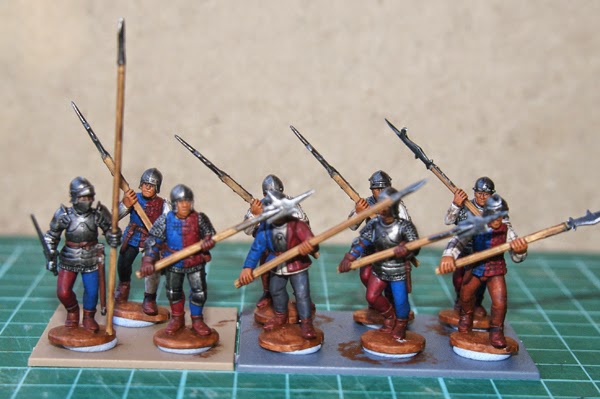
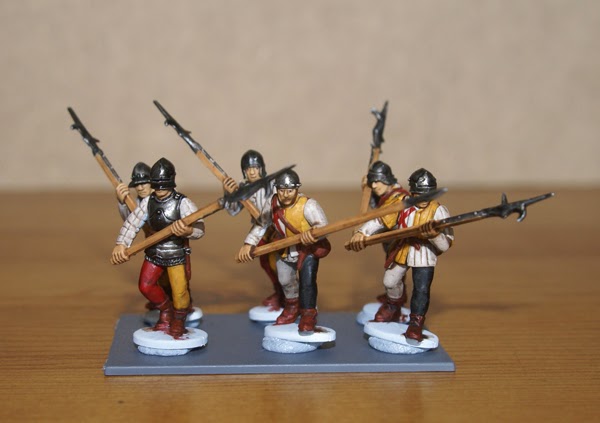
As with the other factions for this army, the two archer units were accompanied by a section of billmen. Much more armour on these, so to maintain colour-scheme cohesion I bit the bullet and went with liveried brigandines.
The front rank of this temporarily-based unit shows the hose variation. The chap second from right seems particularly loyal, having selected hose in his team colours - no doubt taking a cue from his standard bearer.
Another two factions from one of my favourite wars. Clifford I knew well from family research, but Tiptoft and his butcherous ways were relatively new to me. These were both for the same client, and represented both ends of the painting scale, as far as interest and challenge goes...
Clifford first - and his coat colour was white. Not the most exciting scheme to paint, and not the most interesting to look at when finished. Not quick to paint either - as white doesn't cover terribly well. Glutton for punishment, I went ahead and did some white hose as well!

I've tried to vary the white here and there (some more brownish, some more greyish). There are several ways to do this, and I used them all on this job. The guy in the centre front is wearing a sleeveless white livery coat over a white padded jack. To show that they're two garments, the 'wash' on the sleeves is lighter. With hindsight, I'd have switched these and made the sleeves dirtier / livery coat lighter. The chap on the right has a tint of grey in the colour of his livery coat, contrasting with the warmer brown of the padded sleeves. Because he's all in white, I needed a third 'colour' for his hose. This was done using a very pale grey and a lighter shading wash. The chap on the left is meant to be wearing a sleeved garment, so he gets the same treatment all over, but with the 'dirt' applied more to the outer sleeves and lower coat, showing that this is dirt on white, rather than a dirty shade of white.

Among all the dirty white and muted browns, some of the chaps leap out. One such is the chap in centre front, with his 'look at me' parti hose and jacket (under padded jack). When temporarily grouping the minis for photographing, I should pay more attention. I've put three boar spears and three identical bills in the same group of six.
More of the colourful ones. Red / white / blue makes a great combination for unit colours, even when it's just for accents (as here). Makes for some great flags too.
Now to the other end of the scale. I got the Tiptoft scheme from a reenactment society, and it looks great. It's basically quartered yellow / white, but with a great big red saltire in the upper left. This made it much more interesting to paint, though I still messed about with 'alternative whites'.
Not all the body mouldings were suitable for the livery, so some (like the chap front left) got plain white padded jacks, but 'Tiptoft themed' hose. This preserves the overall red / yellow / white unit colours. As you can see from the other two front-rankers, I stuck to neutrals for most of the hose.

The saltire is easy enough to paint freehand, you just go straight from corner to corner, but this is less straightforward when the soldier has pushed his livery coat open to show off his breastplate. After experimentation (crumpling paper flags!), it ends up looking something like a letter 'I' with dents in the top and bottom serif. Different issues were encountered with the brigandine (middle chap). No brush wants to paint straight when bobbling over rivets. In the end, after botching two and having to correct them, I hit on a knack. Paint the line between the rivets only, then go back and touch in the rivets. Of course, if you're doing fancy coloured rivets (exposed metal or contrasting paint) you'd do this anyway.

Eagle eyed regulars will notice that the skin tone is different to my usual 'soldiering in summer'. This one is a Games Workshop colour (Kislev Flesh), but I probably won't use it much in future. It works pretty well over white primer (as with these chaps) but even two coats over grey primer still looked corpse-like. Maybe I'll use it for fresh corpses, or an army of Nu-rock teenagers.
Large unit of 36 late medieval foot men-at-arms using the Perry Miniatures kit, with a few components from their mounted men-at-arms kit and the command frames from the Wars of the Roses archers / billmen set.
They look more impressive en masse than in smaller groups (as pictured elsewhere), though the lack of base treatment spoils the effect. The odd splash of colour here and there from livery coats worn over armour adds interest. I've also painted some of the leatherwork in brighter colours, rather than the red/tan that I normally employ.

The 'left wing' split off to show 18 of them deployed in line - or as near as medieval troops get to being lined up. I've tried to keep a mix of pole weapons / swords to reinforce that this is not a unit in the modern sense, but rather a grouping of the best close-quarter fighters - equipped the way they want to be (or can afford!). Part of the joy of plastic kits is this easy variation - I know some wargamers like lines of identically-posed troops, but I'm not such a fan of this where medieval armies are concerned. With metal troops, even a really big range, you're mostly only talking about a handful of poses (sometimes with head variations). Of course, you can mix ranges... but where the height and build differences are not a problem (people naturally vary in size!), explaining away the difference in levels of detail or style of sculpting is less easy.

The right wing, with the front rank showing four different examples of two-handed swordsman. The yellow-coated chap doesn't look entirely comfortable to me. He's meant to look ready for action, but next time I combine these components (upright body, two handed sword arms) I'll twist the arms to give him a less horizontal guard.
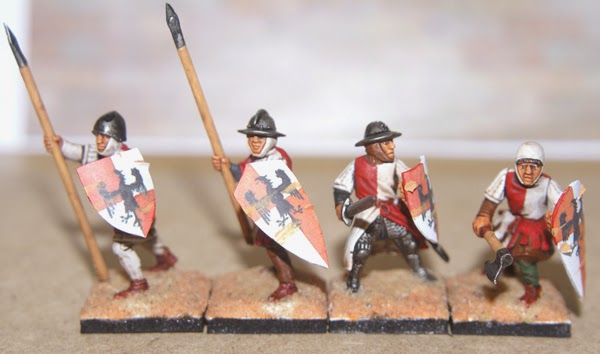
A recent commission for Fireforge footsoldiers, reusing a red-and-white scheme which has been popular in the past;
A mixture of spears and hand weapons (half and half), and all with liveried shields apart from the two-handed axeman. As with most such units, I mixed components from several Fireforge kits (they're almost completely interchangeable - brilliant).
With bright schemes (such as red/white) I tend to use mostly neutral colours for hose etc. I went a bit wild with the spearman on the left though, and his bright blue tunic. Shields are my usual paper-on-plastic, allowing for easy damaging (simulating a leather cover which has seen some action).
The miniature second from right uses a Templar Sergeants body. It's one of my favourite mouldings, as it captures the 'turning to notice incoming infidel' moment nicely. The fact that it's also easy to 'quarter' when painting is just a bonus...
I don't often use the 'non-helmet' heads, but I think with this lighter colour scheme they work okay. You get several shield styles in the kit, and some work better than others with the various bodies. The long ones (centre pair) working best with upright posture, and the shorter shields (guy on the left) better with more active / crouching posture. As you can see from the chap on the right, longer shields with crouching posture equals difficult to rank up (which is why he's on the end of the lineup).
The two-handed axeman is an attempt to offer something which breaks up the line of shields when ranking the miniatures up. Not everyone wants that, but it draws the eye.
After a long while without posting, I'm finally finding time to update! First, a quick refresher of commission prices / pricing structure;
Basic charge for 28mm work is £3.50 per miniature for foot, £6.50 for mounted. This includes basic basing (plain plastic bases with sand / green texturing, as featured in most of the pictures). Cost of the miniature is not included, and you can either supply these yourself (get in touch and I'll let you know where to post them to) or I can source them for you. I can also base in different ways - MDF bases, Games Workshop style, clear plastic - and for different rulesets.
Most of my work is medieval / ancient / fantasy, and the pricing above reflects this. More complex uniforms (Napoleonics, other 18th century, etc.) command a premium, pricewise. The base price for such miniatures is £5.50 foot / £8.50 mounted.
I've
decided to extend the 'bundle' concept for commission work, as it seems
to be working well and is convenient for so many people. Basically, this involves one or other of the excellent plastic miniature kits available now and also includes the cost of the miniatures themselves. I've repeated
the list of popular options below (most of these can also be found on
eBay);
Unit of ten Fireforge crusader footsoldiers £35.00
Unit of six Fireforge crusader knights (mounted) £45.00
Unit of twelve Fireforge Steppe Warriors £42.00
Unit of ten Gripping Beast Arab Archers £35.00
Unit of ten Gripping Beast Arab Spearmen / Swordsmen £35.00
Unit of ten Perry Afrika Korps £29.50
Unit of ten Perry 8th Army £29.50
Unit of four Perry SAS / LRDG £10.95
Perry DAK MG34 or mortar team (two miniatures) £6.00
Perry 8th Army Bren gun or mortar team (two miniatures) £6.00
Unit of ten Perry Wars of the Roses longbowmen £35.00
Unit of ten Perry Wars of the Roses billmen £35.00
Unit of eighteen Perry Wars of the Roses foot men-at-arms £63.00
Unit of ten Perry 15th Century handgunners £35.00
Unit of ten Perry 15th Century pikemen £35.00
Unit of ten Perry 15th Century crossbowmen £45.00 (includes pavises)
Unit of six Perry 15th Century mounted men-at-arms £45.00
Unit of six Perry 15th Century light cavalry / hobilars £45.00
Check
out my previous postings for painted examples of all of the above. You
choose the scheme / weapon options / basing style, or leave it up to me
if you like. Postage and packing on all orders, large and small, is
£7.00 flat rate (UK), £10.00 Europe, £15.00 rest of the world.
Of
course, 'normal' commission work (painting whatever you've got, in
whatever quantities you have) is still available, email me for a quote!
I'm pretty busy at the moment, but I carry out work first-come,
first-served, so it's still worth getting your orders in as soon as you
know what you want. I can advise on likely delivery times when you
place your order.
If you have any questions, of any sort, you can contact me on deadkingsrise2008@yahoo.co.uk